Europe's engines powering Artemis II
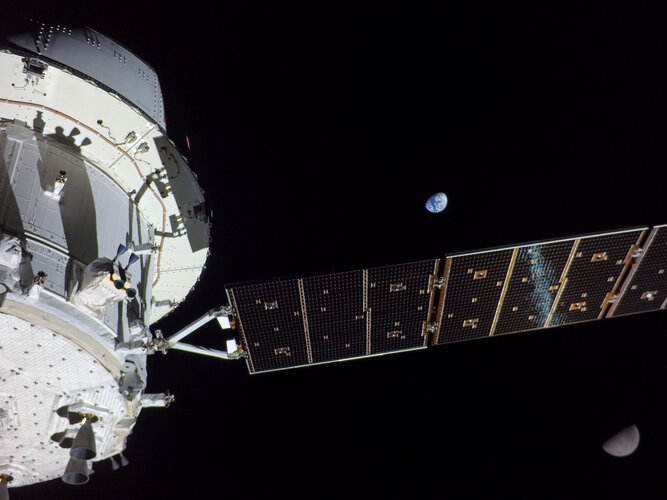
Europe’s contribution to NASA’s Artemis II mission will be the European Service Module (ESM), the propulsion core of Orion that will carry astronauts beyond Earth orbit for the first time in five decades. Built by European industry and integrated into the Orion spacecraft, the ESM will power the crewed flight scheduled for launch from Kennedy Space Center, with the trans‑lunar injection burn planned for the second day of the mission. The collaboration involves engineers from ESA’s ESTEC facility in the Netherlands and NASA’s Mission Evaluation Room at Johnson Space Center in Houston, who will monitor the module throughout the flight.
The ESM houses 33 engines arranged in three functional groups. A single main engine, a refurbished Space Shuttle orbital maneuvering system unit that flew on six shuttle missions between 2000 and 2002, provides the large velocity change required for the trans‑lunar injection. Eight auxiliary engines support orbital corrections and can serve as backups for the main engine. Precise attitude control is achieved with 24 reaction‑control system thrusters distributed across six pods, enabling Orion to rotate and orient itself with fine accuracy. After launch, Orion will remain in Earth orbit while the crew checks systems, then separate from the upper stage and use the reaction‑control thrusters for proximity‑operations training before the main engine ignites to send the spacecraft on a four‑day trajectory toward the Moon. Additional firings will fine‑tune the path, keeping the vehicle on course for the lunar flyby and return.
Artemis II marks the second flight of a European Service Module, following the uncrewed Artemis I mission where the ESM exceeded performance expectations. The successful operation of the first module has reinforced Europe’s role in the Artemis program, and two further modules have already been delivered and are undergoing testing for upcoming missions. Continued delivery of ESM hardware positions Europe as a key supplier for the series of crewed lunar missions planned through Artemis III and beyond, underscoring the strategic partnership between ESA and NASA in human deep‑space exploration.


