Artemis Moon Tree Dedicated in Honor of Mary W. Jackson
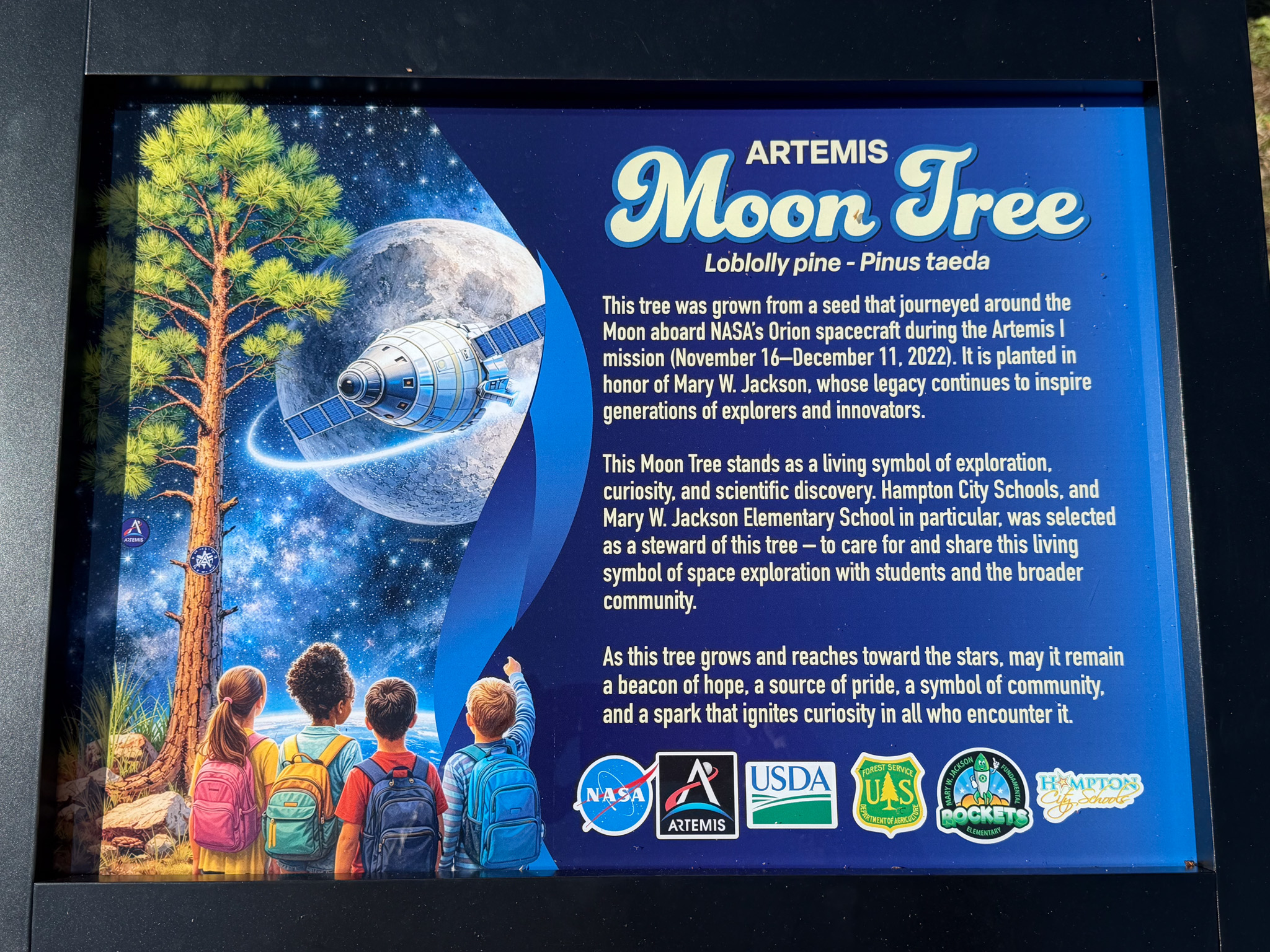
NASA’s Langley Research Center and a coalition of educators marked the dedication of an Artemis Moon Tree at Mary W. Jackson Elementary School in Hampton, Virginia, on 18 March 2026. The ceremony gathered students, school staff, Langley personnel and representatives from NASA’s Office of STEM Engagement, celebrating a loblolly pine that had been in the ground since its planting on 21 November 2025. The event highlighted the school’s namesake, Mary W. Jackson, NASA’s first Black female engineer, and underscored the partnership that enabled the tree’s arrival on campus.
The tree’s seed orbited the Moon in 2022 aboard the Artemis I launch vehicle before re‑entering Earth’s atmosphere and being cultivated into a sapling by the U.S. Department of Agriculture Forest Service. After a spring 2025 delivery to Hampton, NASA eClips educators from the National Institute of Aerospace’s Center for Integrative STEM Education (NIA‑CISE) supervised its care until third‑ through fifth‑grade students performed the planting. Student teams labeled Earth Excavators, Compost Crew, Mulch Movers and Water Brigade each handled a specific task, from soil placement to watering, mirroring the coordinated effort required for space missions. The tree joins an Apollo‑era Moon Tree, a sycamore planted in 1976 at Albert W. Patrick Elementary School, creating a living timeline that links the Artemis program to earlier lunar outreach.
Positioned in a city that hosted NASA’s earliest research and Project Mercury astronauts, the Artemis Moon Tree serves as a tangible reminder of the agency’s multi‑generational exploration heritage. Its presence complements Hampton’s legacy of pioneering mathematicians and engineers such as Katherine Johnson, Dorothy Vaughan and Christine Darden, reinforcing the community’s historical contribution to spaceflight. By entrusting the tree’s stewardship to the school’s students and staff, NASA extends its science activation goals, providing a continual educational resource that connects classroom learning to the broader narrative of lunar exploration.