NASA Awards Astrophysics Postdoctoral Fellowships for 2026
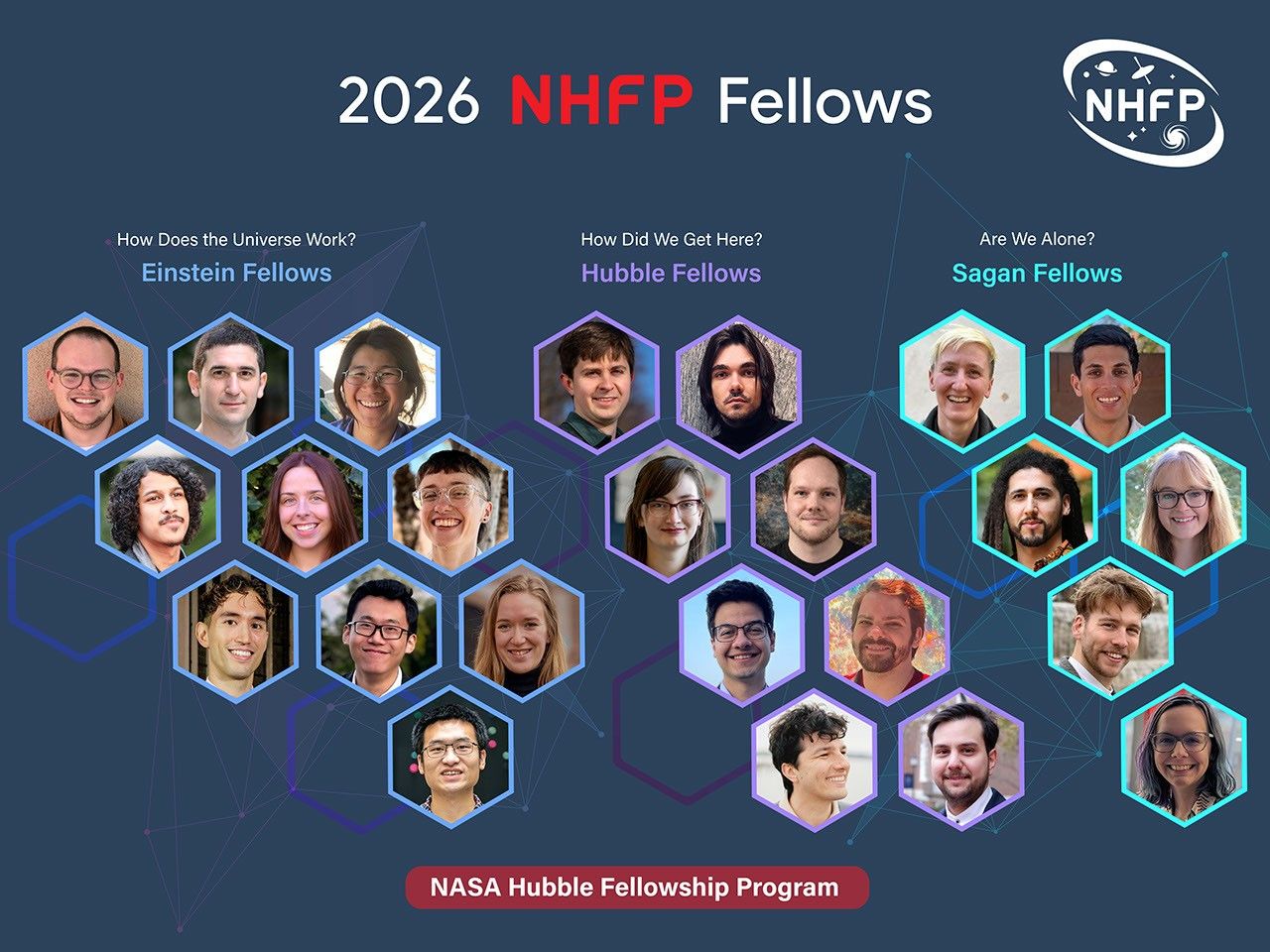
NASA announced on 25 March 2026 that the Hubble Fellowship Program has selected 24 postdoctoral researchers for the 2026 class. The awardees were chosen from more than 650 applicants, an oversubscription of 27 to 1, and will receive up to three years of funding to conduct independent research at U.S. institutions. The program, administered by the Space Telescope Science Institute in Baltimore, Maryland, operates on behalf of NASA in partnership with the Chandra X‑ray Center, the NASA Exoplanet Science Institute and the Jet Propulsion Laboratory.
The 2026 fellows are divided among three thematic streams: Einstein, Hubble and Sagan. Einstein Fellows include researchers at Princeton, Stanford, Caltech, Carnegie Observatories, MIT, Johns Hopkins, Harvard, CUNY and the Smithsonian Astrophysical Observatory, tackling topics such as early supermassive black‑hole growth, primordial physics, compact‑object demographics and dark‑matter mapping. Hubble Fellows, based at institutions including the Institute for Advanced Study, MIT, Notre Dame, Columbia, UT‑Austin, Stony Brook, Carnegie Mellon and Johns Hopkins, will study turbulence in star‑forming regions, dark‑matter thresholds, galactic archaeology and the earliest faint galaxies. Sagan Fellows from the University of Kansas, Harvard, Chicago, Arizona, Caltech, NRAO and other centers will focus on exoplanet magnetism, JWST and Roman direct imaging, atmospheric escape, Doppler detection of Earth‑like planets and prebiotic chemistry. Each fellow’s project aligns with NASA’s overarching astrophysics questions about the universe’s workings, its evolution and the potential for life elsewhere.
The fellowship class will convene at the annual NHFP symposium, a venue that in 2025 was held at the Space Telescope Science Institute and featured presentations on JWST planetary atmospheres, early‑galaxy observations and Dark Energy Spectroscopic Instrument data releases. By integrating postdoctoral talent across the nation, the program reinforces U.S. leadership in space‑based astrophysics, expands the scientific output of host universities, and supplies a pipeline of researchers who will contribute to forthcoming NASA missions and instrument development.