NASA-JAXA’s XRISM Telescope Clocks Hot Wind of Galaxy M82
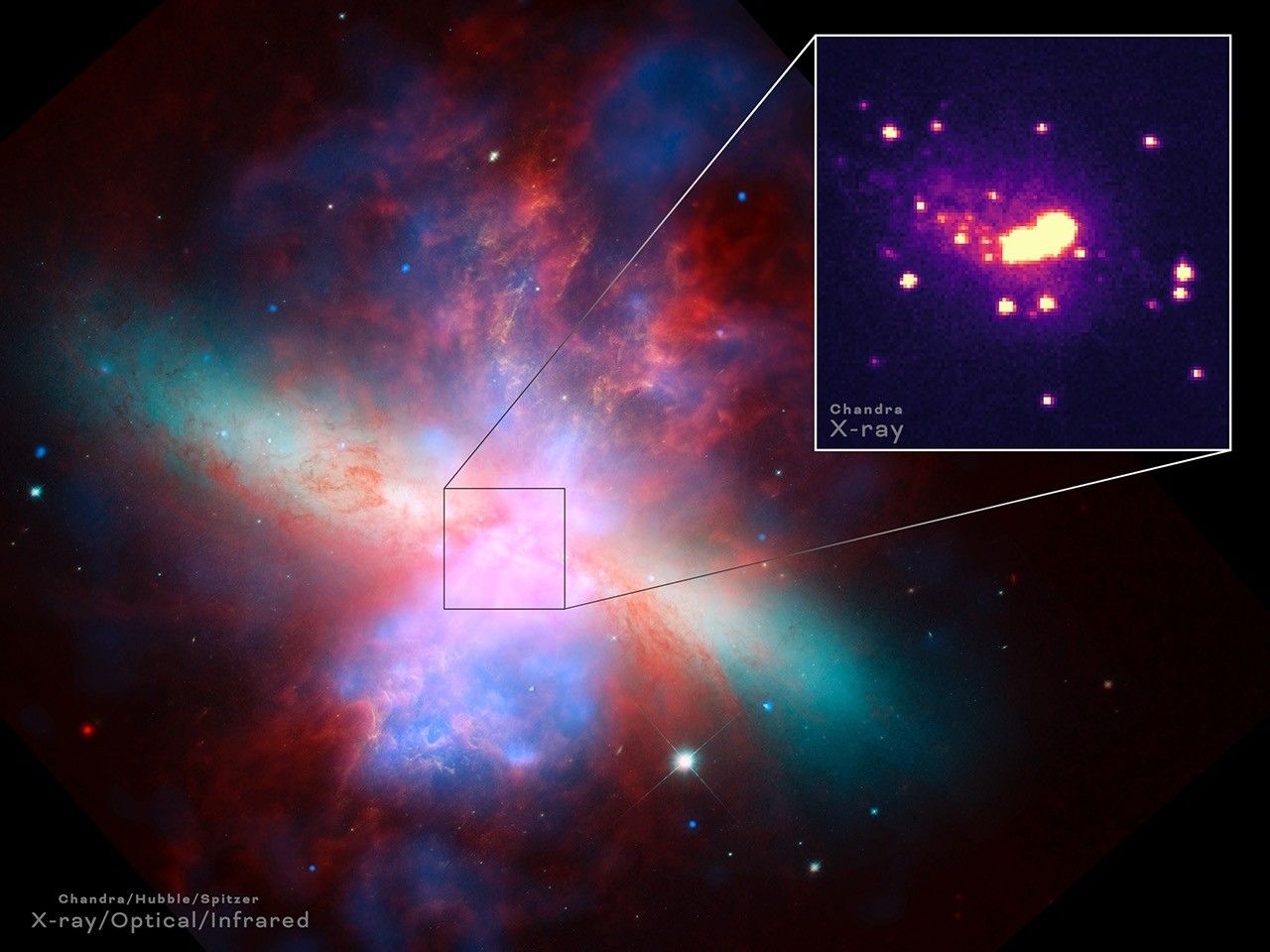
NASA’s Goddard Space Flight Center and Japan’s Aerospace Exploration Agency announced on 25 March 2026 that the Resolve spectrometer aboard the X‑ray Imaging and Spectroscopy Mission (XRISM) has directly measured the velocity of super‑heated gas flowing from the core of the nearby starburst galaxy M82. The international team, led by astrophysicist Erin Boettcher of the University of Maryland and Goddard, used XRISM data to determine that the hot wind moves at more than two million miles per hour, confirming a key prediction of starburst‑galaxy theory. The measurement was published in Nature the same day, marking the first time an X‑ray mission has provided the required velocity precision for such a study. M82, located roughly twelve million light‑years away in Ursa Major, has long been a laboratory for investigating galaxy‑scale outflows that extend up to forty thousand light‑years from its nucleus.
The Resolve instrument captured high‑resolution X‑ray spectra of iron emission lines from the galaxy’s central region, allowing the team to assess both temperature and bulk motion through Doppler broadening. Analysis of the line profiles indicated a plasma temperature of about forty‑five million degrees Fahrenheit (twenty‑five million degrees Celsius) and a bulk speed of roughly three million kilometres per hour, slightly faster than most theoretical models anticipate. The hot wind’s kinetic energy appears sufficient to drive the well‑studied cool wind without invoking additional pressure from cosmic rays, although the latter may still contribute. Calculations based on the measured flow suggest the core expels enough material each year to form four to seven solar‑mass stars, raising questions about the fate of the excess mass. XRISM’s Resolve spectrometer was co‑developed by NASA and JAXA, with contributions from the European Space Agency, and the observation complemented archival data from Chandra, Hubble, Spitzer and the James Webb Space Telescope.
The result provides the first empirical test of starburst‑galaxy wind models first formulated in the 1980s, offering a benchmark for simulations of feedback processes that regulate galaxy evolution. By confirming that shock heating from intense star formation can launch a wind powerful enough to shape a galaxy’s interstellar medium, the finding refines expectations for future high‑resolution X‑ray missions. XRISM’s success underscores the value of international collaboration in delivering instruments capable of probing extreme astrophysical environments and informs the design of next‑generation observatories aimed at mapping energetic outflows across the cosmos.