NASA Webb, Hubble Share Most Comprehensive View of Saturn to Date
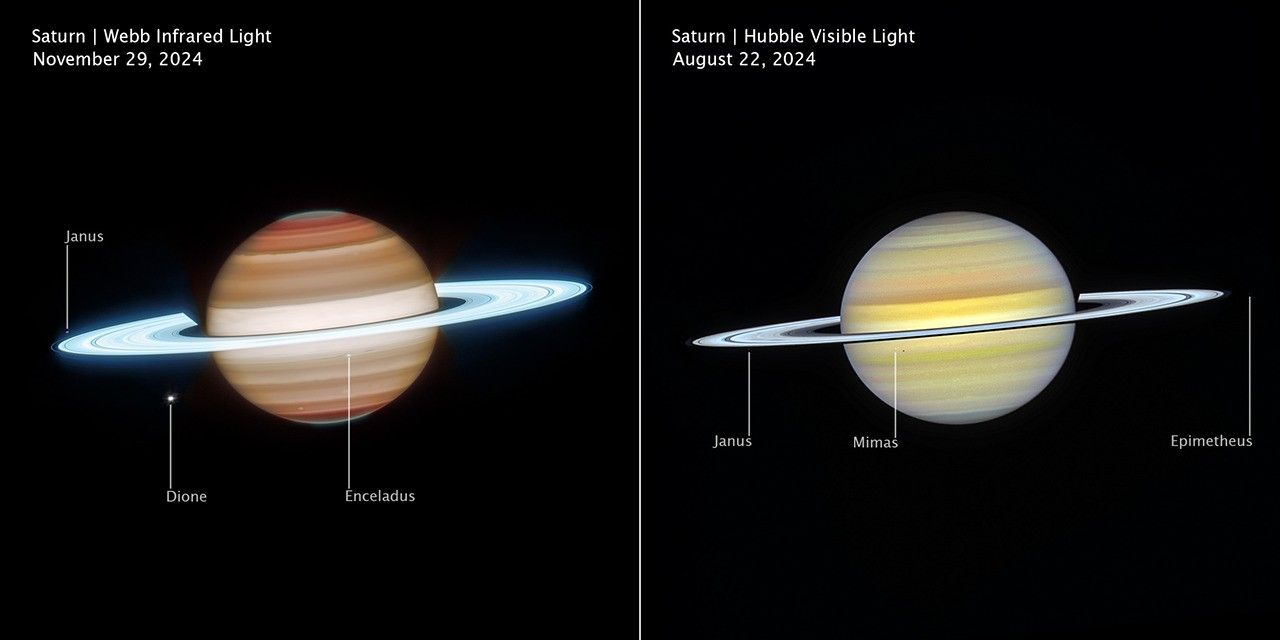
NASA announced on 25 March 2026 that the James Webb Space Telescope and the Hubble Space Telescope have jointly produced the most comprehensive imaging of Saturn to date. The visible‑light picture was captured by Hubble on 22 August 2024 as part of the Outer Planet Atmospheres Legacy (OPAL) monitoring program, while Webb obtained an infrared view on 29 November 2024 using Director’s Discretionary Time. Both observations were released together, offering a side‑by‑side comparison of the gas giant’s atmosphere, rings and moons from complementary wavelengths.
Webb’s Near‑Infrared Camera (NIRCam) recorded Saturn’s thermal emission at wavelengths near 4.3 µm, revealing a grey‑green polar hue that may indicate high‑altitude aerosols or auroral activity. Hubble’s Wide Field Camera 3 (WFC3/UVIS) highlighted subtle color variations across the planet’s banded clouds, including the persistent hexagon jet stream at the north pole first seen by Voyager in 1981. The infrared image shows the “ribbon wave” jet stream across the northern mid‑latitudes, a lingering spot from the 2010‑2012 Great Springtime Storm, and multiple southern‑hemisphere storms, while the visible‑light frame captures the same hexagon edges and the bright icy rings that reflect sunlight. Six major moons—Janus, Dione, Enceladus, Mimas, Epimetheus and Titan—are discernible in the wider Webb view, and the F ring appears thin and crisp in the infrared data compared with its faint glow in the Hubble picture. The two sets of data were taken 14 weeks apart, documenting Saturn’s progression from northern summer toward the 2025 equinox, and they complement earlier measurements from the Cassini orbiter (1997‑2017). The missions are managed by NASA’s Goddard Space Flight Center, with Hubble operations run by the Space Telescope Science Institute in Baltimore and Webb supported by ESA and CSA partners.
The combined dataset extends OPAL’s decade‑long record of Saturn’s atmospheric evolution by adding high‑resolution infrared diagnostics, enabling researchers to “slice” through the planet’s atmosphere at multiple altitudes. By integrating Webb’s thermal sensitivity with Hubble’s visible‑light precision, scientists can better characterize fluid‑dynamic processes, seasonal shifts and ring microstructures. The images also mark the last high‑resolution view of Saturn’s northern hexagon expected before the planet’s north pole enters a 15‑year winter darkness in the 2040s, underscoring the importance of the current observations for future comparative planetary studies.