NASA’s IXPE Gets Fresh Look at Supernova
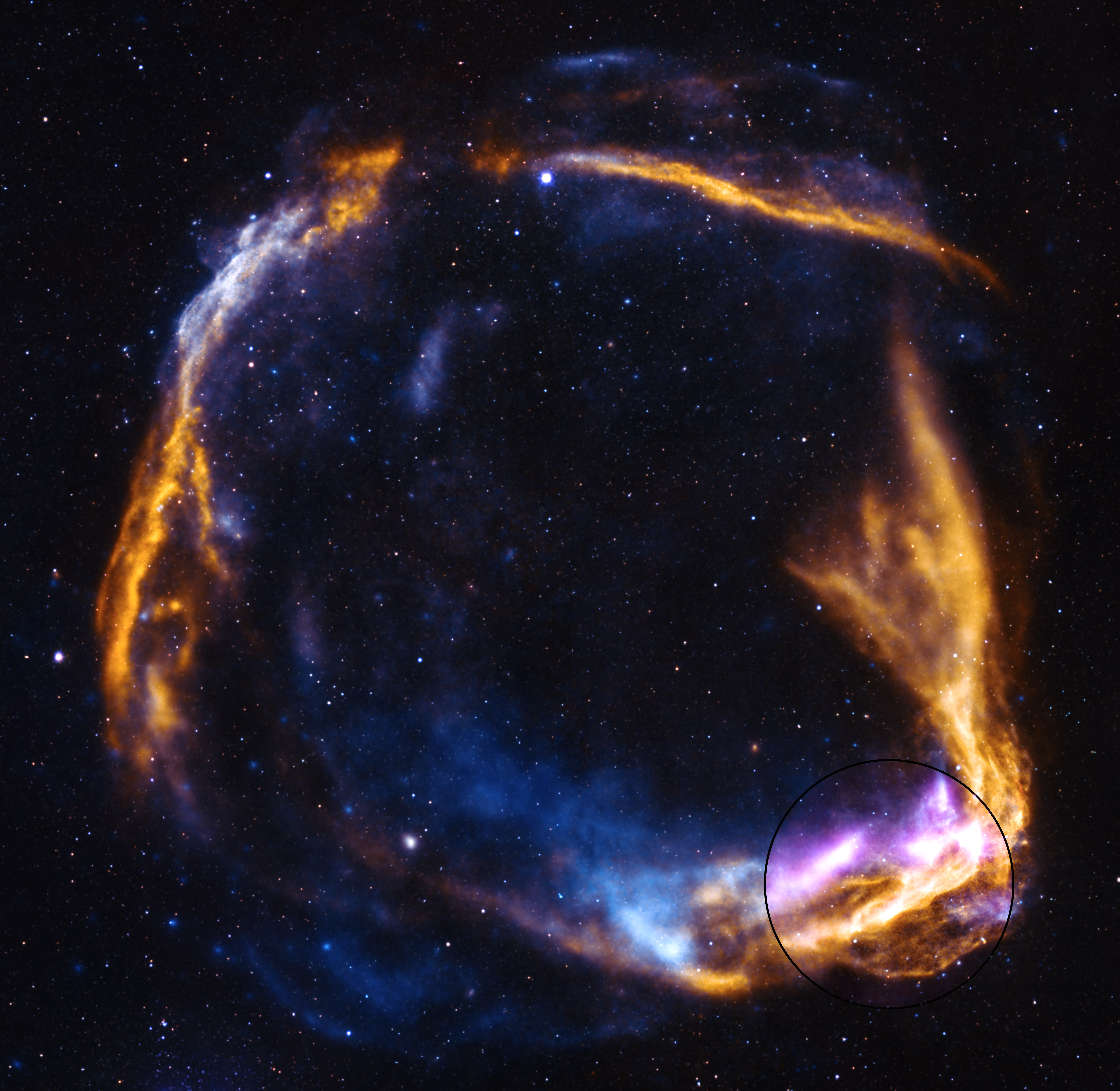
NASA’s Imaging X‑ray Polarimetry Explorer (IXPE) captured a new observation of the supernova remnant RCW 86, and the composite image was released on 24 March 2026. The data set joins IXPE’s X‑ray polarimetry measurements with archival observations from NASA’s Chandra X‑ray Observatory and the European Space Agency’s XMM‑Newton telescope, providing a refreshed view of the remnant’s structure. The release highlights the collaborative effort among NASA, ESA and the National Science Foundation’s National Optical‑Infrared Astronomy Research Laboratory (NOIRLab) to broaden the scientific picture of this historic explosion.
The composite picture integrates low‑energy X‑ray emission, rendered in yellow, with high‑energy X‑ray emission, shown in blue, as recorded by Chandra and XMM‑Newton. Optical background stars are supplied by NOIRLab, creating a full‑color context for the X‑ray features. Image credit lists Chandra (NASA/CXC/SAO), XMM‑Newton (ESA/XMM‑NEWTON), IXPE (NASA/MSFC), and the optical contribution (NSF/NOIRLab), while processing was performed by J. Schmidt at NASA’s Chandra X‑ray Center and the Smithsonian Astrophysical Observatory. The combined dataset demonstrates IXPE’s capacity to contribute polarimetric insight alongside spectral and imaging data from established X‑ray observatories.
The observation underscores the growing role of X‑ray polarimetry in multi‑wavelength supernova research, complementing the high‑resolution imaging that Chandra and XMM‑Newton have delivered for decades. By merging polarimetric, spectral and optical information, the IXPE team adds a new dimension to the analysis of RCW 86, a remnant that continues to inform models of shock physics and particle acceleration. The joint effort reflects an expanding framework of international cooperation, where NASA, ESA and NSF assets are routinely integrated to enhance the scientific return of space‑based missions. Continued exploitation of IXPE’s polarimetric capabilities is expected to refine interpretations of existing X‑ray archives and guide future observations of high‑energy astrophysical phenomena.