Webb Captures Saturn in Infrared
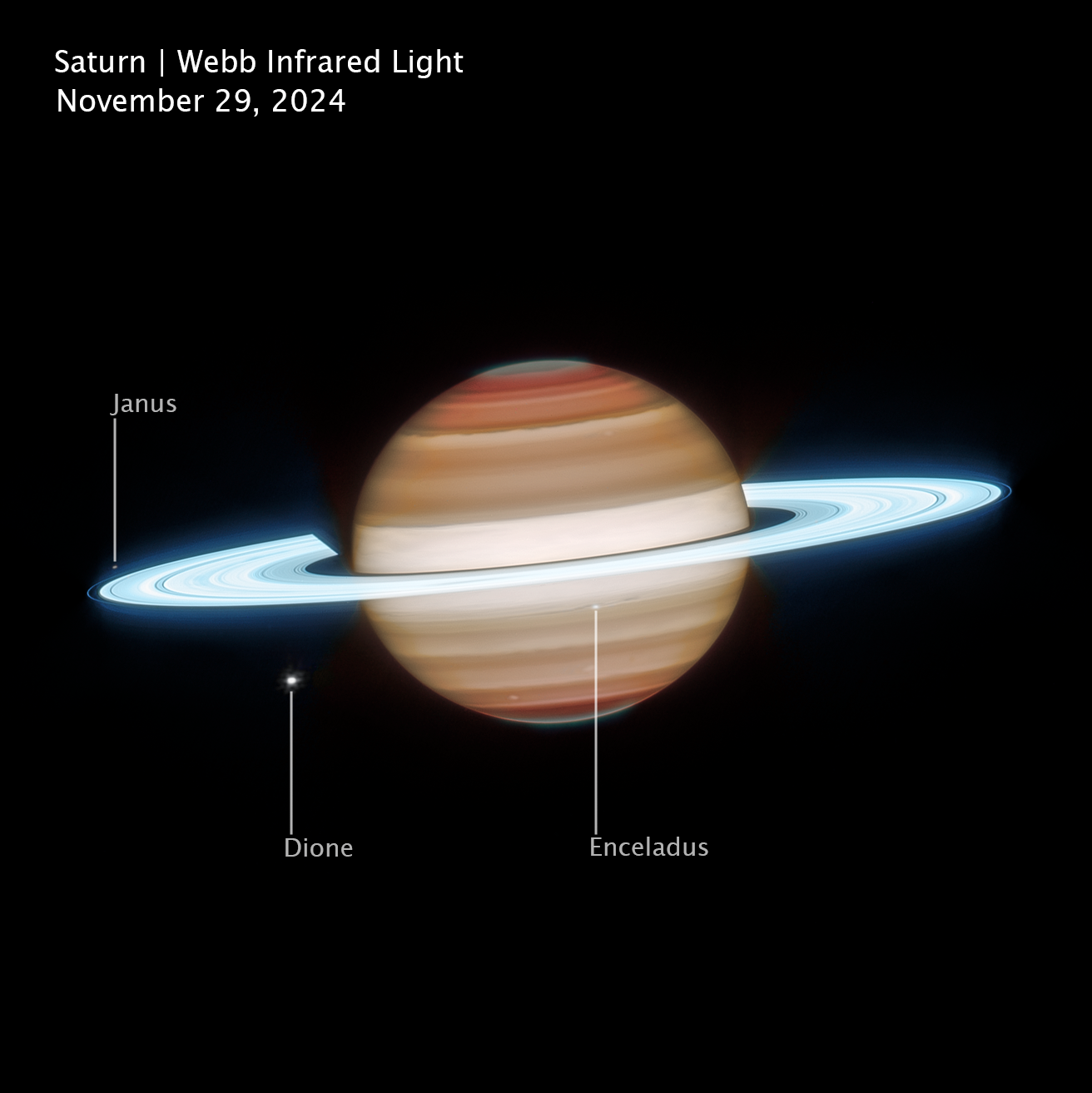
NASA’s James Webb Space Telescope captured an infrared image of Saturn on 29 November 2024, and the agency released the picture on 25 March 2026. The observation shows the planet’s icy rings and atmospheric layers, while also revealing several of its moons, including Janus, Dione and Enceladus. The image was produced by a collaboration involving NASA, the European Space Agency, the Canadian Space Agency and the Space Telescope Science Institute, with processing handled by Joseph DePasquale at STScI. The release coincided with a complementary view of Saturn taken by the Hubble Space Telescope, providing scientists with paired data sets from two flagship observatories.
In the Webb infrared view, Saturn’s rings appear exceptionally bright because they consist of highly reflective water‑ice particles that dominate the near‑infrared spectrum. The planet’s polar regions display a distinct grey‑green hue, corresponding to emissions near 4.3 microns; this signature may arise from a high‑altitude aerosol layer that scatters light differently at the poles, or from auroral processes driven by charged molecules interacting with the magnetic field. The combined analysis of Webb’s infrared data and Hubble’s optical imaging offers a more layered understanding of the gas giant’s atmospheric composition and dynamics. The observation also confirms the visibility of multiple moons in the same frame, demonstrating the telescope’s spatial resolution and sensitivity across a broad wavelength range.
The joint release underscores the strategic value of coordinated observations between space‑based platforms, reinforcing the role of Webb as a complement to Hubble for planetary science. By delivering high‑resolution infrared measurements of Saturn’s rings, atmosphere and satellites, the data set supports ongoing efforts to model giant‑planet weather systems and ring particle properties. The collaboration among NASA, ESA, CSA and STScI reflects a continued international partnership that leverages shared assets to expand the scientific return of flagship missions. Insights gained from this dual‑observatory approach are expected to inform future studies of outer‑planet environments and to guide the design of upcoming missions targeting the Saturn system.