NASA’s Hubble, Webb Telescopes Survey Pinwheel Galaxy
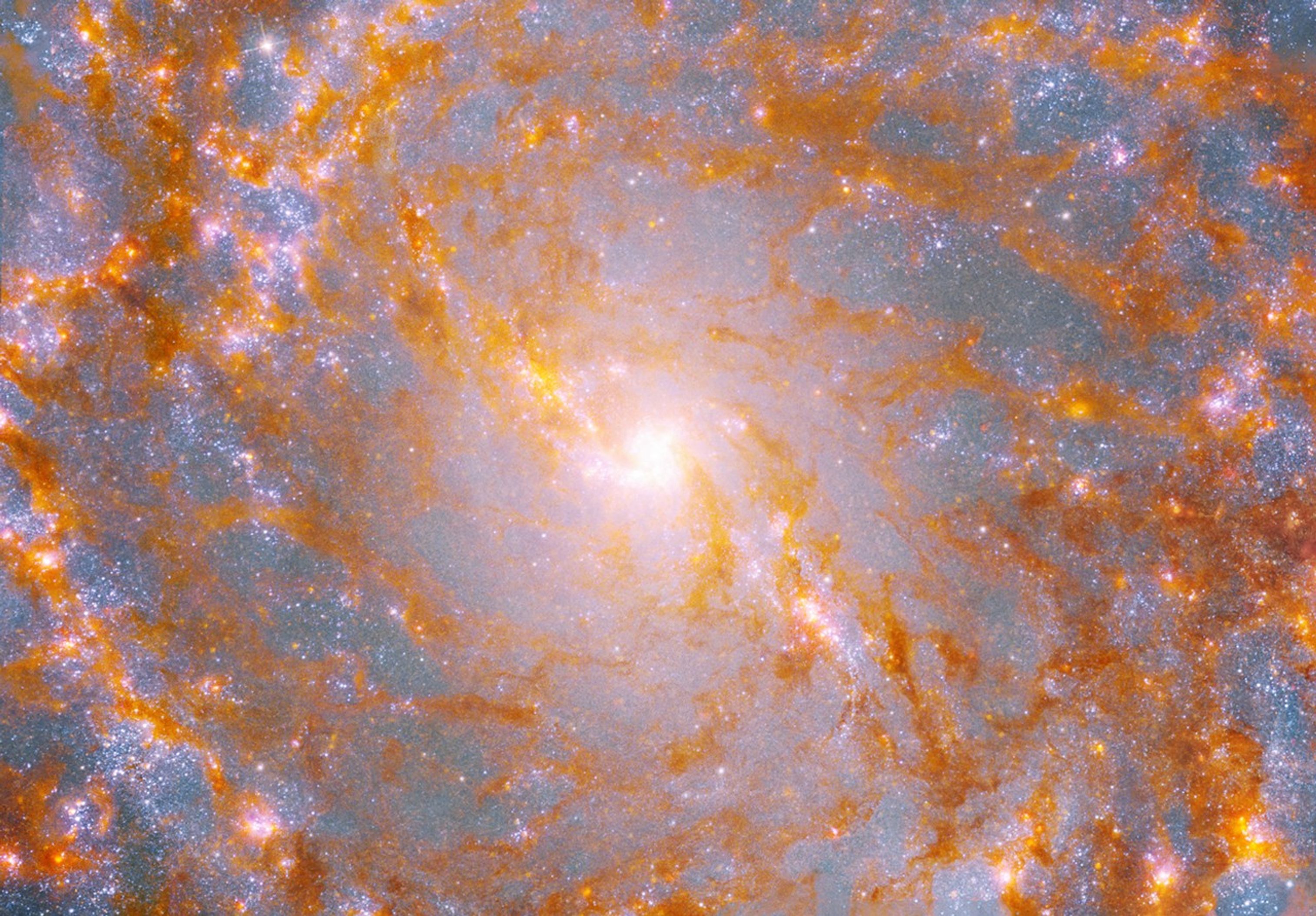
NASA’s Hubble Space Telescope and the James Webb Space Telescope captured a coordinated view of the Pinwheel Galaxy, also catalogued as Messier 101, revealing structural details in one of the nearest face‑on spiral galaxies on March 16, 2026. Located roughly 25 million light‑years away in the constellation Ursa Major, the composite data highlight the galaxy’s core region with enhanced clarity, showing how ultraviolet, visible, and near‑infrared observations trace distinct features of its stellar populations and spiral arm patterns. The combined imaging supports ongoing studies into the dynamics of galactic disks and the distribution of star formation across large spiral systems.
Hubble’s ultraviolet and visible light measurements reveal concentrations of young, luminous stars and the intricate pattern of dust lanes that define M101’s sprawling arms, while Webb’s infrared instruments probe cooler dust and complex molecular signatures that are often obscured at shorter wavelengths. The synergy between the telescopes enables scientists to discern variations in stellar age, composition, and interstellar medium structure without relying on speculative interpretation beyond what the multi‑wavelength dataset directly shows. With contributions from the Canadian Space Agency (CSA) and the European Space Agency (ESA) alongside NASA, the survey illustrates how high‑resolution optical and infrared imaging together map galactic anatomy at multiple scales.
Astronomers use Messier 101 as a benchmark for spiral galaxy morphology because its expansive disk and well‑defined arms provide a template for comparing star formation environments in similar galaxies. Earlier observations of the Pinwheel Galaxy by Hubble and other observatories have established a baseline for its large‑scale structure, but the fresh combination with Webb’s data refines models of how dust, gas, and newly formed stars are arranged in a grand‑design spiral. The enhanced view has implications for understanding the late stages of galactic evolution and the processes that govern stellar birth in extended galactic disks.